
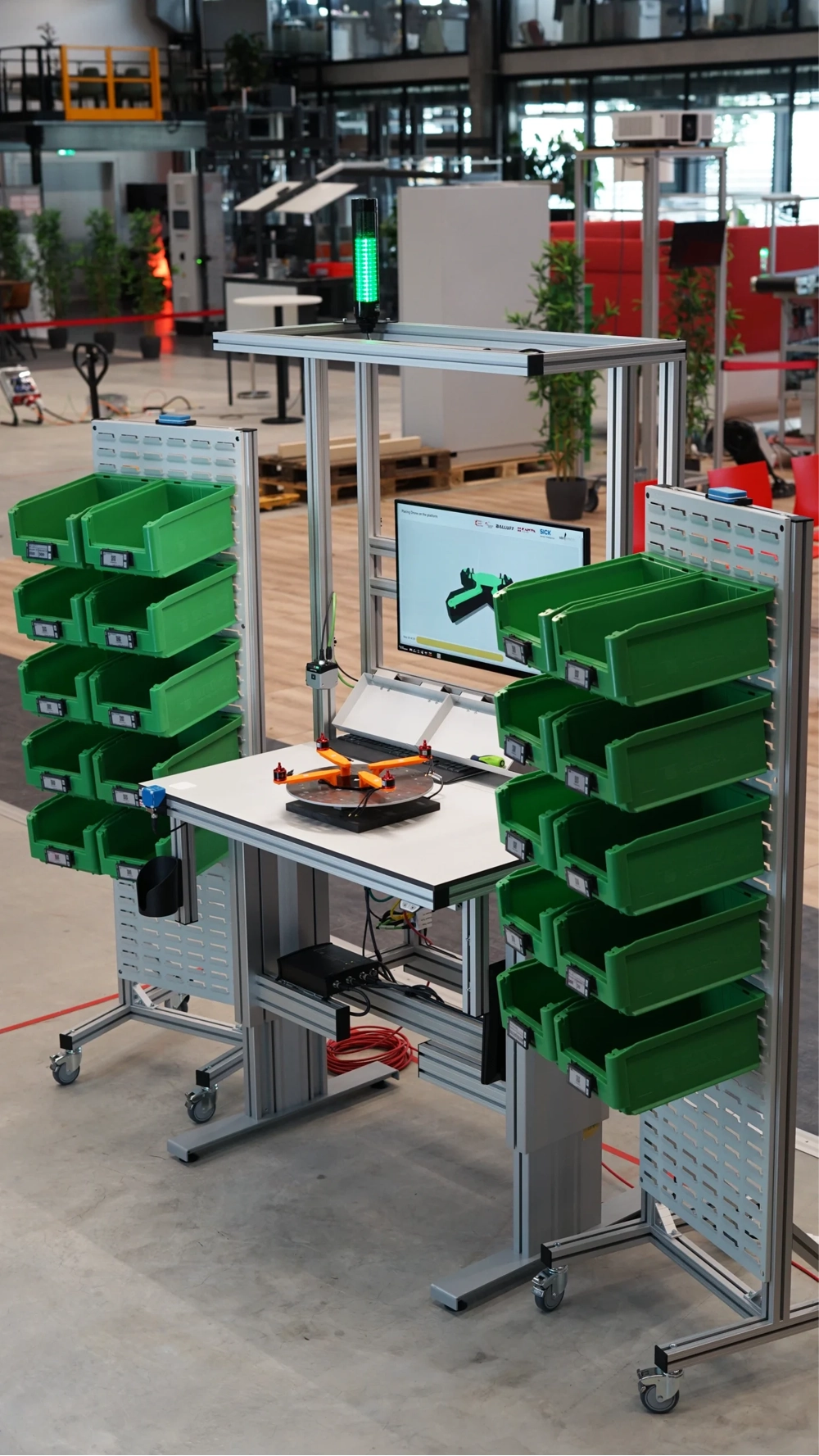
How the Swiss Smart Factory is testing a human-centric demanufacturing workstation using real industrial products, smart sensors and digital traceability.
At a glance
Objective
Validate a flexible, human-centric workflow for industrial demanufacturing.
Use case
Guided disassembly, component assessment and lifecycle traceability.
Technologies
RFID, IO-Link, code reading, sensors and Digital Product Passports.
Overview
The Swiss Smart Factory developed a semi-automated demanufacturing workstation to explore how returned, used or end-of-life products can be disassembled, assessed and redirected toward reuse, repair, recycling or disposal.
The station combines operator guidance, product identification, sensor data and digital traceability. Instead of aiming for full automation, the approach focuses on a hybrid workflow where human expertise is supported by smart tools and structured decision-making.
The Challenge
Demanufacturing is difficult to industrialise because returned products are rarely identical. Their condition, configuration, level of damage and available product information can vary significantly.
For SMEs, fully automated disassembly is often too rigid, too expensive or too complex to deploy. A more realistic approach is to support operators with adaptable instructions, product data, smart sensors and decision-support tools.
This is especially relevant for circular manufacturing, where companies need to decide whether components should be reused, repaired, recycled or discarded.
The Approach
The demanufacturing workstation was designed as a modular and flexible setup where the operator is guided step by step through the disassembly process.
The current station uses product information and sensor feedback to structure the workflow. The product can be identified, weighed, checked and documented during the process. The objective is to reduce manual uncertainty while keeping the flexibility needed for products with different conditions and configurations.
The next development step is to automate part of the creation of disassembly instructions by using existing product and manufacturing knowledge, such as Digital Product Passports, Asset Administration Shells, digital twins and knowledge-based decision support.
Key Takeaways
Three principles shape the workstation and make the concept transferable to industrial SMEs.
Human-centric automation
Operators remain in control while digital guidance and sensors reduce uncertainty.
Traceable decisions
Identification and process data support consistent reuse, repair, recycling or disposal decisions.
Modular architecture
The setup can evolve with new products, data sources and decision-support services.
System Architecture
The pilot uses an open and modular reference architecture. Industrial devices are connected on-premise through IO-Link and Bluetooth, while Node-RED orchestrates device data, operator guidance and REST API exchanges with cloud traceability services.

Technology Stack
Products and software integrated in the current reference implementation.
Identify & measure
Connect & monitor
Guide & orchestrate
- Node-RED workflow tool
- FlowFuse, project partner
- Side Effects VApp operator interface
- Windows edge PC
Trace & share
How the Data Flows
| Source | Interface | Destination | Purpose |
|---|---|---|---|
| Load cell, RFID, signal lamp, code reader and condition sensor | IO-Link | SICK SIG300 | Collect and expose field-device data |
| SICK SIG300 | REST API | Windows edge PC / Node-RED | Orchestrate the demanufacturing workflow |
| NERIOX caliper | HID over Bluetooth | Windows edge PC | Capture manual measurements |
| Side Effects VApp | HTML | Operator screen | Provide step-by-step and interactive 3D guidance |
| Node-RED | REST API | PDi Digital and BloqSens | Update smart labels and Digital Product Passport records |
Replication Path
- Build the workstation. Adapt the modular frame, work surface, storage bins and operator screen to the product and available floor space.
- Connect the field devices. Select the sensors needed for identification, weighing, measurement and condition assessment, then connect the IO-Link devices to the SIG300.
- Configure the edge layer. Install Node-RED on the Windows PC and implement the device and REST API flows required by the use case.
- Create the operator workflow. Model the disassembly sequence, decision points, data capture and interactive instructions.
- Add traceability. Connect smart labels and a Digital Product Passport service to record product and component outcomes.
- Adapt and validate. Replace products or services as needed, then validate ergonomics, decision quality and cycle time with operators.
Workflow at a Glance

Demanufacturing Workstation Workflow
- Product identification. The product or component is identified using RFID, QR code or smart label technologies.
- Guided disassembly. The operator follows structured disassembly instructions supported by a digital interface.
- Sensor-based documentation. Weight, identification data and process feedback are captured during the operation.
- Component assessment. Each component is assessed to determine whether it can be reused, repaired, recycled or discarded.
- Traceability update. Relevant information can be linked to a Digital Product Passport to document the product lifecycle and support future circularity decisions.
Partners